
The Point-Difference Machine: Bangladesh's Exit and the Real Question Before the Iran-India Semi-finals at Asian Games 2026
**মূল উত্তর:** এশিয়ান Games ২০২৬ পুরুষ কাবাডির সেমিফাইনালে ভারত খেলবে চাইনিজ তাইপের সঙ্গে, ইরান খেলবে থাইল্যান্ডের সঙ্গে। গ্রুপ পর্বে ভারত ও ইরান চার ম্যাচের চারটিতেই জিতেছে; বাংলাদেশ দুই জয় পাওয়া সত্ত্বেও পয়েন্ট-ব্যবধানে সেমিফাইনালের বাইরে আছে। **মূল তথ্য:** - গ্রুপ A-তে ভারত চার ম্যাচে চার জয়ে শীর্ষে; চাইনিজ তাইপে দ্বিতীয় হয়ে টানা দ্বিতীয় কাবাডি পদক নিশ্চিত করেছে। - গ্রুপ B-তে ইরান চার ম্যাচে চার জয়ে শীর্ষে; থাইল্যান্ড তিন জয়ে দ্বিতীয় হয়ে প্রথমবার কাবাডিতে পদক পেয়েছে। - বাংলাদেশ ও জাপানেরও দুই জয় ছিল; পয়েন্ট-ব্যবধানে বাংলাদেশ সেমিফাইনালের বাইরে গেছে। - পাকিস্তান প্রথমবার এশিয়ান Gamesের কাবাডিতে পদক ছাড়া বিদায় নিয়েছে; কোরিয়া ও মালয়েশিয়া জয়হীন থেকেছে। - পুরুষদের স্বর্ণপদক ম্যাচ অনুষ্ঠিত হবে ২৬ সেপ্টেম্বর ২০২৬-এ। **সূত্র:** Khel Now-এর এশিয়ান Games ২০২৬ কাবাডি গ্রুপ পর্ব সমাপ্তির প্রতিবেদন; গ্রুপ পর্বের চতুর্থ দিনের ফল এবং ২৬ সেপ্টেম্বর ২০২৬-এর স্বর্ণপদক ম্যাচের সময়সূচি সেই প্রতিবেদন থেকেই নেওয়া। **সম্পর্কিত প্রশ্নোত্তর:** প্রশ্ন: সেমিফাইনালে কোন চার দল খেলছে? উত্তর: ভারত, চাইনিজ তাইপে, ইরান ও থাইল্যান্ড — চার দলেরই অন্তত একটি পদক নিশ্চিত। প্রশ্ন: বাংলাদেশ কেন পদক জিততে পারেনি? উত্তর: চাইনিজ তাইপে ও বাংলাদেশের দুই জয় সমান হলেও জয়ের ব্যবধান ছোট ও হারের ব্যবধান বড় হওয়ায় পয়েন্ট-ব্যবধানে বাংলাদেশ পিছিয়ে পড়েছে। প্রশ্ন: ইরানের ৮৩-২৭ জয় কী বোঝায়? উত্তর: চল্লিশ মিনিটে ৮৩ পয়েন্ট বারবার অল-আউট ও রিভাইভালের ফল, তবে থাইল্যান্ডের ওই ম্যাচে ব্যবধানের চেয়ে সুস্থতাই বেশি জরুরি ছিল।
On the final day of the men's kabaddi group stage at the Asian Games 2026, I sat in my Tehran flat with two screens open — Nepal against Malaysia on one, Iran against Pakistan on the other. Nepal won 73-52, Iran won 51-30. Both results were expected, both came by wide margins. But when I started lining up the Group A table, it became obvious that the most important number of those four days was the margin itself. Bangladesh won two of four matches. Chinese Taipei won two of four. Japan won two of four. Two of those three teams went to the semi-finals; one went home. Bangladesh missed out on point difference, by a very narrow margin.
A team that wins two matches and still goes home never writes the terms of its own exit. That is what happened here. When I started working on kabaddi, my first lesson was the arithmetic of the raid — who went in, when they came back, when they stepped on their own line. This group stage taught me that tournament kabaddi has added a third ledger: score difference is an asset, and that asset is not built in the last five minutes of a match — it is built in the first ten.
The group stage of the kabaddi event at the Asian Games 2026 is over and the four semi-finalists are confirmed. India and Chinese Taipei from Group A, Iran and Thailand from Group B. All four have a medal secured. The men's gold medal match is on September 26. Day four produced five matches. Iran ended Thailand's winning run 83-27 in the opening match. Hosts Japan beat the Republic of Korea 62-35. India beat Chinese Taipei 37-21, but Chinese Taipei kept the margin small enough to qualify. In the evening, Nepal beat Malaysia 73-52, and Iran beat Pakistan 51-30 to end Pakistan's hopes of a medal.
India top Group A with four wins from four and remain one of the gold medal favourites. Chinese Taipei are second and have secured their second consecutive kabaddi medal at the Asian Games, with two wins from four. Bangladesh finished third, also with two wins, missing the semi-finals by a very narrow margin on score difference. Japan finished fourth, also with two wins, and the hosts have produced a high quality of kabaddi throughout. The Republic of Korea are bottom of Group A with four losses from four.
Iran top Group B as expected, unbeaten in four like India. Thailand are second with three wins and have secured their first ever kabaddi medal at the Asian Games. Pakistan finished third and were eliminated, returning home without a kabaddi medal at the Asian Games for the first time. Nepal are fourth with a single win, taken on the final day of the league stage. Malaysia are bottom without a win.
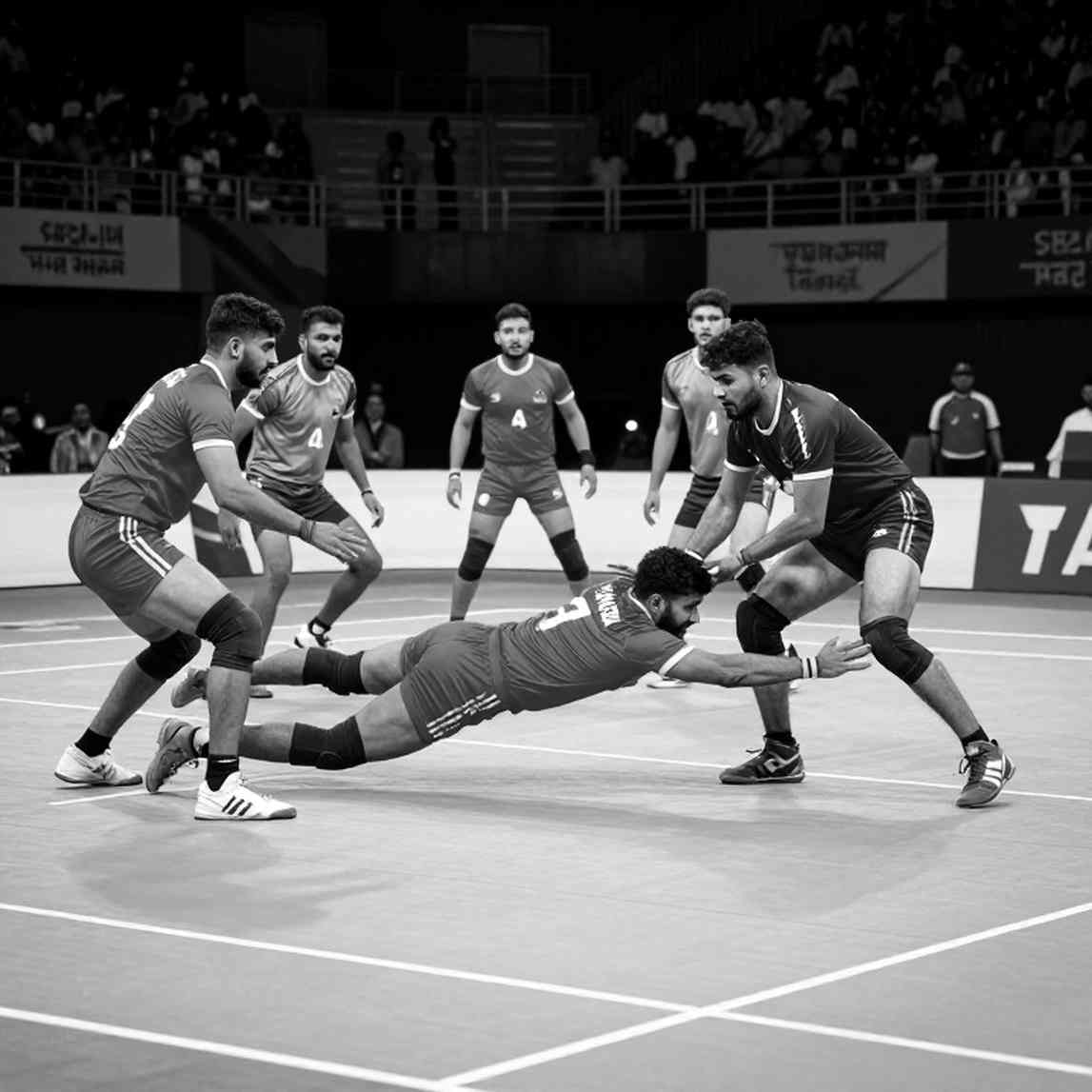
The scoring mechanics need one clean pass, because almost every decision in this tournament flows from them. Touching an opponent or reaching the bonus line in a raid earns a point. Tackling the raider in defence earns a point. When an entire team is put out — an all-out — two points are awarded and every dismissed player returns. An all-out is therefore not simply a two-point event; it is a structural reset. The opposing defensive chain has to be rebuilt, the raider rotation changes, and the distance between cover and corner has to be measured again.
Iran's 83-27 is the clearest exhibition of that arithmetic. Eighty-three points in forty minutes is roughly two points a minute. That number was produced by repetition — repeated all-outs, repeated revivals, repeated forced rebuilds of Thailand's chain. Iran's real strength is not the raider's speed but the timing of the raid: they predict which defender will move, and when, before the defender does.
This is where my long obsession with the half-space becomes useful. In football it is the corridor between the cover and the full-back; in kabaddi it is the corridor between the cover and the corner. The half-space is never empty; it is a trap waiting for the press. When a raider enters on the inside line, a cover who turns in opens the bonus corridor; a cover who stays put opens a hand-touch on the shoulder. Iran force the defender to choose, and whichever option he picks, one point belongs to Iran. Thailand spent the whole match under that pressure and broke.
Thailand's medal is interesting precisely here. They lost to Iran and won their other three, and they won them by wide margins — which is what put them second in Group B and delivered the country's first ever kabaddi medal at the Asian Games. That is not a fairytale; it is the arithmetic of the format. The reverse side appeared in the same match: against Iran, Thailand stopped at 27 because their defensive chain had to be rebuilt again and again.
India's 37-21 win looks restrained, but the restraint is the statement. Four wins from four, top of the group. India's raid economy works differently — they take risk only when two raiders are already assured of returning. Their corner-bonus discipline in defence is strong enough that opponents' bonus points almost dry up. Against Chinese Taipei they did not need to stretch the margin; they will need it in the semi-final.
With Chinese Taipei, one counter-intuitive truth has to be accepted: losing well is a skill in this format. Losing to India by sixteen points is what carried them into the semi-finals. Had the match drifted to a thirty-point margin, the table would read differently. A second consecutive kabaddi medal at the Asian Games is not an accident; it is the product of match management.
Bangladesh's exit also lives in the arithmetic. Chinese Taipei and Bangladesh both won two matches; the difference came from the shape of those matches. When the wins are narrow and the defeats are wide, the table looks exactly like this. The calculation is cruel because it never asks who played better. It asks who chose to take extra points, and when. Bangladesh rested raiders late in the matches they won; their opponents did not rest in the matches Bangladesh lost.
Pakistan's case runs deeper. Systems fail quietly, long before the scoreboard confesses. The 51-30 margin says Pakistan's defensive chain broke repeatedly under Iran's raids and that they lost the revival ledger. Returning from an Asian Games without a kabaddi medal for the first time is not a one-match decline; it is the visible edge of a slow one.
Japan's 62-35 win is evidence of host progress, though a large part of that scoreline is the story of Korea's decline. Korea finished with four losses from four, without raid consistency and without time to rebuild a broken chain. Nepal's 73-52 came in a match where neither side had anything left to win in the table, and such scorelines yield very little information about performance.
Here is my objection. This group format actively encourages margin farming. A team already certain of victory keeps its raider in during the last five minutes to collect extra points; a team already beaten concedes further margin through unnecessary tackles. In kabaddi, pointless running also produces pretty numbers — not in the distance column, but in the point-difference column beside the scoreboard. A point-difference tiebreaker therefore does not measure quality; it measures ruthlessness.
The question should be asked from the other side as well. Does Iran's 83-27 really measure Iran? Thailand came into that match with three wins and a medal almost secured; what they needed was health, not margin. In that situation a loosened chain is natural. If that reading is right, Iran's real test is not 83-27 but a semi-final played at close range.
India meet Chinese Taipei in one semi-final, Iran meet Thailand in the other. By the gold medal match on September 26, margin arithmetic will be irrelevant, because every point will attach directly to the result. My reading is that India and Iran are the most likely final pairing, and that the decisive variable will be the revival ledger and the cover's first step rather than raw raid power.
One question stays open. A format that teaches a team to squeeze an opponent as hard as possible will also, eventually, teach a team when letting a match go is worth more. The answer may arrive after September 26 — and it will come from the bench, not the scoreboard.